

Funding Your Business: How to Align Investment with Your Vision

We all have a big vision for where we want our business to go, but figuring out the best way of funding your business can feel a little daunting. The truth is, there’s no “one size fits all” when it comes to capital. Whether you’re looking to scale fast or grow sustainably, the right investment should empower your dream, not complicate it.
We sat down with Elizabeth, a NatWest Acceleration Manager, to demystify the UK landscape for funding your business. She shared some brilliant, real-world lessons on how to navigate your options without losing sight of your “why.”
Let’s dive into how you can find the perfect fit for your unique journey. 🚀
Start with the “Why”
Before you dive into applications, take a moment to reflect on your goals. Misalignment between your funding and your vision can cause significant challenges for both your business and your personal life. To get it right, consider these four key pillars:
- Control: How important is it to you to maintain control? Equity investment involves giving away a stake, which means others may have ideas on how you should run the business.
- Speed: How quickly do you want to build? Think about whether you need a cash injection for rapid sales, marketing, or opening new locations.
- Culture: Funding can impact your business culture in both positive and negative ways. Ensure your chosen path allows you to build the environment you want.
- Exit Strategy: If you pursue equity, your investors will eventually look for a return through an “exit event,” such as an acquisition or going public.
The Reality of the UK Funding Landscape
You might be surprised to learn that while venture capital (VC) gets the most headlines, only 3% of businesses actually access equity investment to fund their growth.
According to data from the Bank of England, the most common way founders are funding their businesses is through bootstrapping – specifically, reinvesting business revenues or using personal funds from owners and directors.
The secret for many successful founders isn’t picking just one path; it’s using different options in tandem. You might bootstrap in the early days, run a crowdfunding campaign for a specific project, and later secure a grant to fuel innovation.
Exploring Your Options
1. Non-Dilutive Funding (Keeping 100% Ownership)
Non-dilutive funding is any type of capital where you don’t have to give away a piece of your company.
- Bootstrapping: This involves reinvesting your own profits or personal cash. While it gives you total control, it relies entirely on your own resources and internal revenue.
- Crowdfunding: For those avoiding equity, project or reward-based crowdfunding allows supporters to give money in return for perks, rewards, or early access to products.
- Grants and Competitions: This is essentially “free money” with no equity or debt attached. These are often run by government bodies like Innovate UK or private companies. For example, the NatWest Accelerator Pitch recently awarded £100,000 to founders in London. While they offer great credibility, they are highly competitive and require a significant time investment for applications.
2. Debt Funding
Debt can be an intimidating word, but it is a standard tool for many growing businesses.
- The Options: These range from bank loans and asset financing (borrowing against the value of equipment or vehicles) to credit cards for short-term cash flow.
- The Upside: Once you are approved, funds are usually accessible quickly. Most importantly, it allows you to maintain full ownership of the business.
- The Catch: You must be able to pay it back, and some options – like credit cards – can be very expensive if used for long-term debt. It can also be harder for very early-stage businesses to meet the criteria for acceptance.
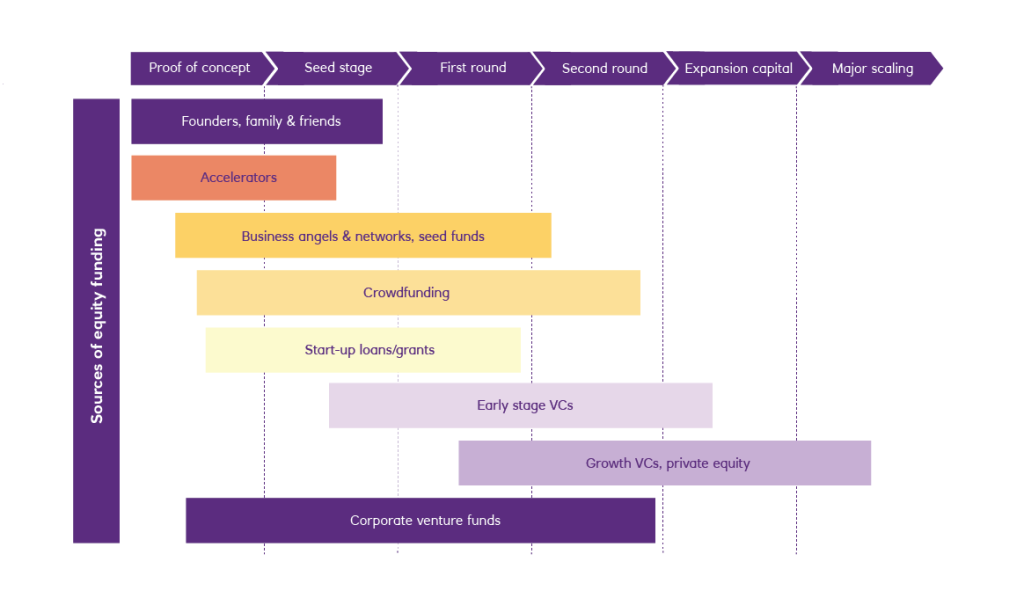
3. Equity Investment
This is when you trade a percentage of ownership for investment.
- The Trade-off: The “due diligence” process is time-consuming and can be costly. You also become responsible to these external stakeholders, who may have their own opinions on how you should run your day-to-day operations.
- Angel Investors & VCs: Angel investors are typically private individuals making personal investments (sometimes starting as small as £500), while Venture Capital (VC) firms are institutional investors looking for high-growth, highly scalable firms.
- Beyond the Money: Equity doesn’t have to be paid back because investors are taking a risk. High-quality investors often provide access to their professional networks, expertise, and a level of validation that can attract even more funding later.
Credit: Natwest
Do You Actually Need Funding?
Before you start the hunt for external capital, it is a useful exercise to ask if you can achieve your goals through more creative, internal means. This helps you retain control and clarifies exactly why you might need a cash injection later. Consider these alternatives:
- Creative Staffing: Instead of hiring a full-time team, could you bring someone in part-time or on a commission basis?.
- Sweat Equity: You might find a partner willing to work in return for a share of the business rather than a high initial salary.
- Strategic Partnerships: Rather than a massive marketing budget, find aligned partners who can refer customers to you in exchange for a referral fee.
- Lean Operations: Think about your specific goal – can it be achieved with a smaller version of the plan that doesn’t require a large upfront investment?.
Proving you can grow with existing resources – or “sweat equity” – often gives you more leverage and control when you finally do decide to seek external funding.
back to feed